Market Insights: Shifting Market Leadership
Milestone Wealth Management Ltd. - Aug 04, 2026
Macroeconomic and Market Developments:
- North American markets were mixed over this week. In Canada, the S&P/TSX Composite Index fell by 0.40%, while in the U.S., the Dow Jones Industrial Average increased by 1.04% and the S&P 500 Index rose by 1.05%.
- The Canadian Dollar increased this week, closing at 71.37 vs. 70.92 cents USD last week.
- Oil prices fell this week, with U.S. West Texas Crude closing at US$84.56 vs. US$90.53 last week.
- The price of Gold rose this week closing at US$4,103 vs. US$4,055 last week.
- The Federal Reserve held its benchmark rate steady at 3.5% to 3.75% for a fifth consecutive meeting, but in a split decision, with three regional presidents (Neel Kashkari, Lorie Logan, and Beth Hammack) dissenting in favour of a quarter-point hike. Chair Kevin Warsh reaffirmed the committee's commitment to its 2% target, noting inflation remains elevated on higher energy prices tied to renewed Middle East tensions. Core CPI eased to 2.6% in June from 2.9%, though the rebound in oil keeps a hike on the table.
- U.S. real GDP grew at a 1.5% annual rate in Q2, below both the 2.0% consensus and Q1's 2.1% pace, with personal spending (up 3.2%) and the AI and data centre build-out doing most of the work. Stripping out volatile categories, "core" GDP rose at a 3.9% rate, its fastest in more than three years, while higher oil prices pushed the GDP price index up 6.2% and nominal GDP up 7.9%. First Trust expects nominal growth to cool from here.
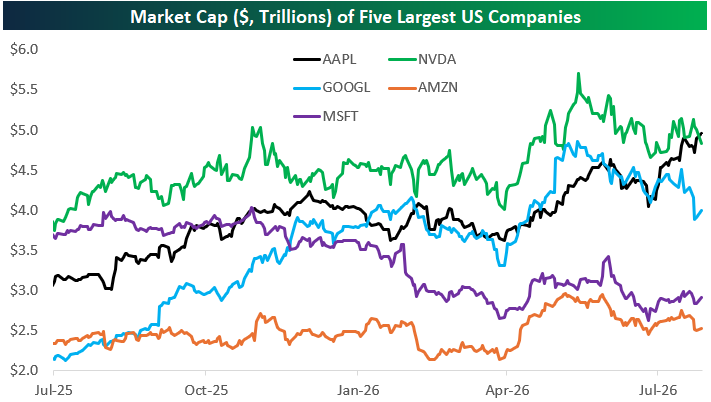
- Apple briefly reclaimed its position as the world's largest publicly traded company, with its market cap slightly eclipsing NVIDIA, before Apple pulled back on Friday. The strength in Apple reflects a rotation away from AI infrastructure names toward Apple's more conservative approach.
- The Gordie Howe International Bridge connecting Windsor and Detroit opened Monday, though the launch was overshadowed by a last-minute dispute after President Trump objected to the original 2012 agreement, under which Canada would have collected all toll revenue until recouping its $6.4 billion in construction costs. A new agreement in principle would split net revenues evenly for the first fifteen years, but disagreement over how "net profit" is defined leaves the terms unresolved and adds to uncertainty around the broader tariff file.
- Microsoft reported 43% growth in Azure and other cloud services revenue in its fiscal fourth quarter, with strong AI and cloud demand pushing its contracted commercial backlog to $678 billion, up 84% from a year earlier. Total revenue rose 18% to $90.0 billion, beating expectations, while Azure topped $100 billion for the full fiscal year and Microsoft 365 Copilot passed 30 million paid seats. The results are fresh evidence that heavy AI infrastructure spending is converting into revenue.
Weekly Diversion:
Check out this video: Putting Physics to the Test
Charts of the Week:
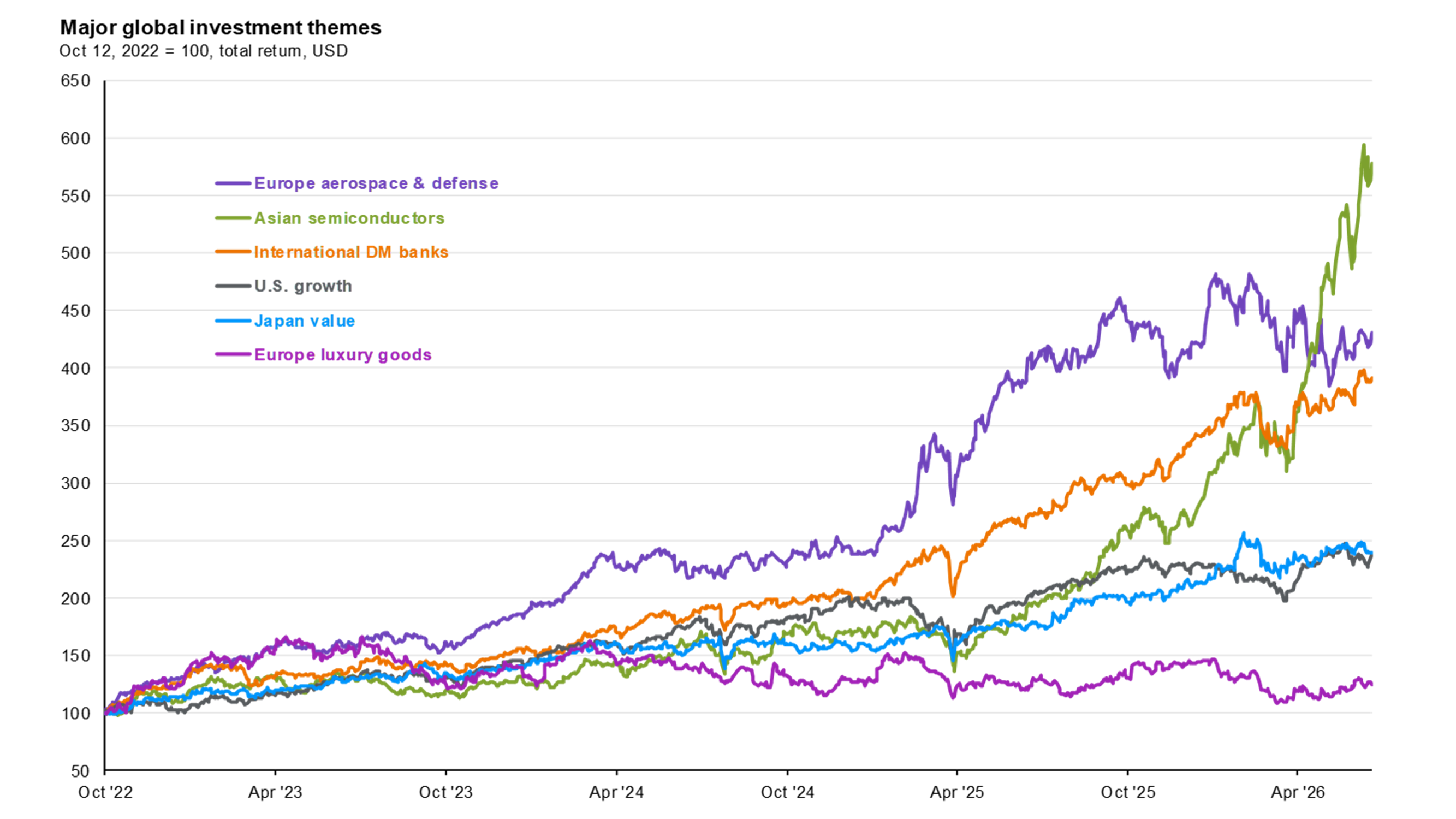
This week’s charts highlight two major market trends: the wide divergence in performance across global investment themes since 2022, and the increasingly close race among the largest U.S. companies by market capitalization. Together, they show how investor leadership has shifted toward areas such as semiconductors, defense, financials, and select mega-cap technology companies.
Source: J.P. Morgan Asset Management
Since October 2022, global investment themes have delivered sharply different results, with Asian semiconductors the standout performer, surging to nearly six times their starting value on strong demand for AI and advanced computing. European aerospace and defense and international developed market banks have also posted substantial gains, supported by higher defense spending and elevated interest rates. U.S. growth stocks and Japan value equities have produced steadier, more moderate returns, while European luxury goods have lagged noticeably amid softer consumer spending in key markets, underscoring a broader rotation toward technology, defense, and financials over the past four years.
Source: Bespoke Investment Group
As noted above, Apple has caught up to NVIDIA and briefly reclaimed its spot as the world's largest publicly traded company before pulling back on Friday. This chart tracks the market caps of the five largest U.S. companies over the past year and shows just how tight the race has become: NVIDIA (green) surged well ahead through the spring, peaking near $5.7 trillion, while Apple (black) climbed steadily to close the gap. Alphabet, Microsoft, and Amazon round out the group, with Microsoft and Amazon drifting lower in recent months as capital rotated toward Apple.
Sources: Yahoo Finance, First Trust, BNN Bloomberg, Bespoke Investment Group
©2026 Milestone Wealth Management Ltd. All rights reserved.
DISCLAIMER: Investing in equities is not guaranteed, values change frequently, and past results are not necessarily an indicator of future performance. Investors cannot invest directly in an index. Index returns do not reflect any fees, expenses, or sales charges. Opinions and estimates are written as of the date of this report and may change without notice. Any commentaries, reports or other content are provided for your information only and are not considered investment advice. Readers should not act on this information without first consulting Milestone, their investment advisor, tax advisor, financial planner, or lawyer. This communication is intended for Canadian residents only and does not constitute as an offer or solicitation by anyone in any jurisdiction in which such an offer is not allowed.