Market Insights: Cooling Inflation, but Seasonal Headwinds Remain
Milestone Wealth Management Ltd. - Jul 24, 2026
Macroeconomic and Market Developments:
- North American markets were mixed over this week. In Canada, the S&P/TSX Composite Index rose by 0.30%, while in the U.S., the Dow Jones Industrial Average decreased by 0.38% and the S&P 500 Index slipped, falling by 0.61%.
- The Canadian Dollar dropped this week, closing at 70.92 vs. 71.34 cents USD last week.
- Oil prices rose again this week, with U.S. West Texas Crude closing at US$90.53 vs. US$81.70 last week.
- The price of Gold fell this week closing at US$4,055 vs. US$4,015 last week.
- U.S. housing starts surged 19.0% in June, far exceeding expectations, driven entirely by a sharp rebound in multi-family construction. However, the underlying outlook for the housing market remains soft, as single-family starts declined, building permits fell to a three-month low, and builder confidence weakened amid elevated mortgage rates, affordability challenges, high construction costs, and ongoing labour shortages. Together, the data suggest housing activity may remain under pressure despite June's strong headline gain.
- U.S. lawmakers released an updated version of the CLARITY Act, introducing new ethics rules that would restrict public officials and their spouses from issuing or promoting digital assets for compensation while in office. The proposed legislation aims to strengthen oversight of the cryptocurrency industry, but key disagreements over stablecoin regulation, banking oversight, and regulatory authority remain unresolved, making passage later in 2026 more likely than during the current legislative session.
- Cross-border travel between Canada and the U.S. continued to recover in May, with Canadian return trips from the U.S. rising 9.9% year-over-year, marking a second consecutive month of growth after a 15-month decline. Travel by U.S. residents to Canada also remained strong, increasing 13% from a year earlier, suggesting improving cross-border tourism despite Canadians continuing to shift a larger share of their leisure travel spending toward overseas destinations.
- Despite widespread concerns that AI investment would reduce hiring, Alphabet added nearly 12,000 employees over the past year, increasing its workforce to almost 199,000 as it continues to aggressively expand its AI capabilities. The company reported strong second-quarter results, with revenue rising 24% year-over-year to $119.8 billion, while also raising its 2026 capital expenditure outlook to as much as $205 billion, reflecting continued heavy investment in AI infrastructure as demand outpaces available capacity.
- Anthropic launched its new Claude Opus 5 AI model, positioning it as a lower-cost, high-performance model for enterprise automation and knowledge work as competition in the AI industry continues to intensify. The release comes as major AI developers race to deploy more advanced models ahead of anticipated public offerings, with Anthropic reportedly preparing for an IPO later this year while continuing to invest heavily in next-generation AI capabilities.
Weekly Diversion:
Check out this video: Just Keep Swimming
Charts of the Week:
The latest U.S. Consumer Price Index (CPI) report, a primary indicator used to calculate inflation and deflation, showed a meaningful cooling of inflation in June. Headline Consumer Price Index (CPI) in the U.S. fell 0.4% month-over-month, compared with expectations for a smaller 0.1% decline. Negative monthly CPI readings are relatively uncommon, and June marked the first negative print since May 2020 and the largest monthly decline since April 2020 in the height of Covid.
Historically, sharp monthly declines in CPI have often occurred around recessions, which makes the context important. Over the last 80 years, there have been 91 negative month-over-month CPI prints, with roughly half occurring during a recession or within one year before or after one. Larger declines have been even more tied to economic weakness: of the 31 CPI declines of 0.3% or more, 21 (68%) occurred around recessionary periods. However, the following chart highlights sharp monthly CPI declines during non-recessionary periods.
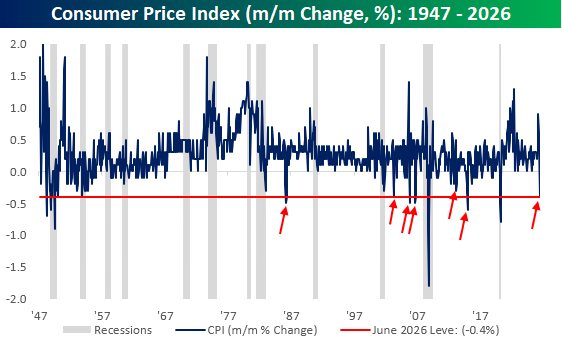
Source: Bespoke Investment Group
The more encouraging signal comes from sharp CPI declines that occurred outside of recessionary periods, like the present time. In addition, our Milestone Recession Risk Composite is currently projecting a very low risk of recession over the next 6-12 months. In those periods, lower month-over-month inflation has often been positive for equities because it can reduce pressure on the Federal Reserve to keep policy restrictive, without necessarily pointing to a major weakening in consumer demand. In June’s case, the decline was largely tied to lower energy costs rather than a broad collapse in demand, which makes the inflation surprise more constructive from a general market demand perspective.
The historical performance following these non-recession CPI declines has been notably positive as the following table shows. In the six distinct prior periods when CPI fell by at least 0.3% month-over-month outside of recessionary windows, the S&P 500 Index was higher three months later every time, with an average gain of 4.0%. Six and twelve months later, the index was higher in five of six periods, with average gains of 4.3% and 14.6%, respectively. The sample size is small, but the consistency of the results is worth noting.
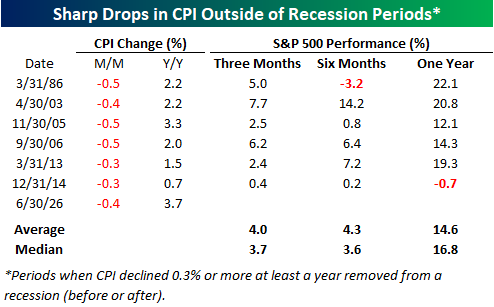
Source: Bespoke Investment Group
The inflation backdrop may be more supportive, but the market is also entering a historically weaker seasonal period. Over the last 25 years, the three-month period beginning around mid- to late-July has been the weakest rolling three-month window of the year for the S&P 500. The following chart shows that the median forward three-month return from July 14 has been slightly negative, making this one of the few points on the calendar where seasonal trends have historically worked against equities.
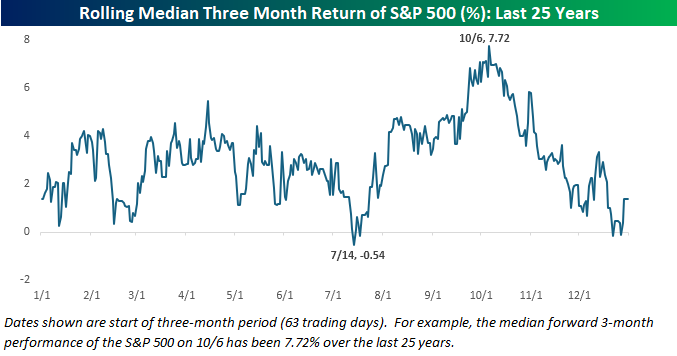
Source: Bespoke Investment Group
This seasonal weakness tended to be less severe when the market was already positive year-to-date. In years when the S&P 500 was lower through July 14, the median return over the next three months was -3.1%, with gains only 38% of the time. When the index was positive year-to-date, the median return improved to +0.6%. In years when the S&P 500 was up at least 5% through July 14 (like present), the median return over the next three months rose to +1.6%, with positive returns 67% of the time.
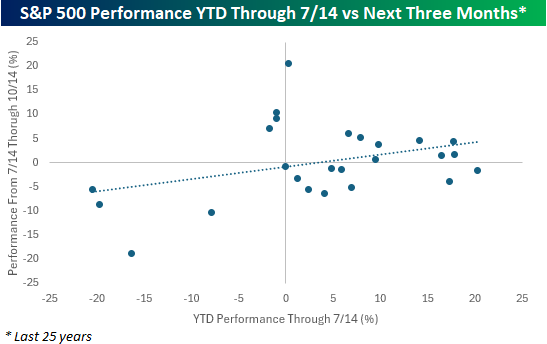
Source: Bespoke Investment Group
For investors, the takeaway is that the setup is mixed but not necessarily negative. A sharp CPI decline outside of a recessionary window has historically been a constructive signal for equities, especially when it reflects easing price pressures rather than weakening demand. At the same time, mid-July has historically started a softer seasonal period for equities. With inflation showing some signs of cooling and the market already well into positive year-to-date territory, the seasonal headwind may be much more manageable, though short-term volatility should still be expected.
Sources: Yahoo Finance, First Trust, The Canadian Press, Global News, FX Street, Business Insider, Bespoke Investment Group
©2026 Milestone Wealth Management Ltd. All rights reserved.
DISCLAIMER: Investing in equities is not guaranteed, values change frequently, and past results are not necessarily an indicator of future performance. Investors cannot invest directly in an index. Index returns do not reflect any fees, expenses, or sales charges. Opinions and estimates are written as of the date of this report and may change without notice. Any commentaries, reports or other content are provided for your information only and are not considered investment advice. Readers should not act on this information without first consulting Milestone, their investment advisor, tax advisor, financial planner, or lawyer. This communication is intended for Canadian residents only and does not constitute as an offer or solicitation by anyone in any jurisdiction in which such an offer is not allowed.