Market Insights: Is Canada’s Aging Workforce Changing the Economy?
Milestone Wealth Management Ltd. - Jun 26, 2026
Macroeconomic and Market Developments:
- North American markets were very mixed this week. In Canada, the S&P/TSX Composite Index inched up by 0.03%, while in the U.S., the Dow Jones Industrial Average increased by 0.60% and the S&P 500 Index fell by 1.95% after a steep decline in the Tech sector.
- The Canadian Dollar was stagnant this week, closing at 70.46 vs. 70.56 cents USD last week.
- Oil prices dropped again this week, with U.S. West Texas Crude closing at US$69.38 vs. US$76.54 last week.
- The price of Gold fell again this week closing at US$4,085 vs. US$4,173 last week.
- Canada’s annual inflation rate rose more than expected in May, climbing to 3.2% from 2.8% in April and moving above the Bank of Canada’s 1% to 3% target range for the first time in 29 months. The increase was largely driven by a 33.2% year-over-year jump in gasoline prices tied to higher crude oil costs. Core inflation remained stable, with CPI-median at 2.1% and CPI-trim at 2.0%, suggesting the Bank of Canada may stay patient as it watches whether energy-driven price pressures broaden or ease in the June data.
- U.S. manufacturing activity improved in June, with S&P Global’s flash manufacturing PMI rising to 55.7, its highest level since May 2022 and above expectations. The strength was partly driven by companies front-loading orders ahead of potential shortages and price increases, while factory hiring weakened sharply, with the employment index falling to 47.0, its lowest reading since May 2020. Input and output prices eased slightly but remained elevated, reinforcing the view that sticky inflation could keep the Federal Reserve cautious on rate cuts.
- U.S. first-quarter GDP was revised higher to a 2.1% annualized pace, above expectations, but the details showed a more uneven economy. Core GDP slowed to 1.7%, its weakest pace since 2022, and personal consumption rose just 0.5%, the slowest pace in four years. Business investment was the clear bright spot, rising 10.6% as AI-related spending on equipment and intellectual property continued to support growth. Overall, the report points to an economy still expanding, with momentum increasingly dependent on business investment as consumer spending softens.
- U.S. personal income and consumer spending both rose 0.7% in May, showing continued household resilience despite persistent inflation pressure. Real consumption increased 0.3%, while PCE inflation rose 4.1% year-over-year and core PCE increased 3.4%, keeping inflation above the Federal Reserve’s comfort zone. The personal savings rate also held at 3.0%, its lowest level since 2022, suggesting consumers are still supporting growth, but with a thinner cushion if prices, borrowing costs, or labour conditions become more challenging.
- Alberta is in discussions with Japan about increasing Canadian crude exports, including a proposal to help fund refining upgrades that would allow Japanese companies to process more heavy oil from Alberta’s oil sands. The talks highlight two important themes for Canadian energy: Japan is looking to reduce its reliance on Middle Eastern oil, while Canada is trying to diversify beyond the U.S., which still receives most Canadian crude exports. With the Trans Mountain expansion improving access to Pacific markets, stronger demand from Japan could support Alberta’s long-term export ambitions and strengthen the case for additional west coast pipeline capacity.
Weekly Diversion:
Check out this video: This Guy Deserves a Medal
Charts of the Week
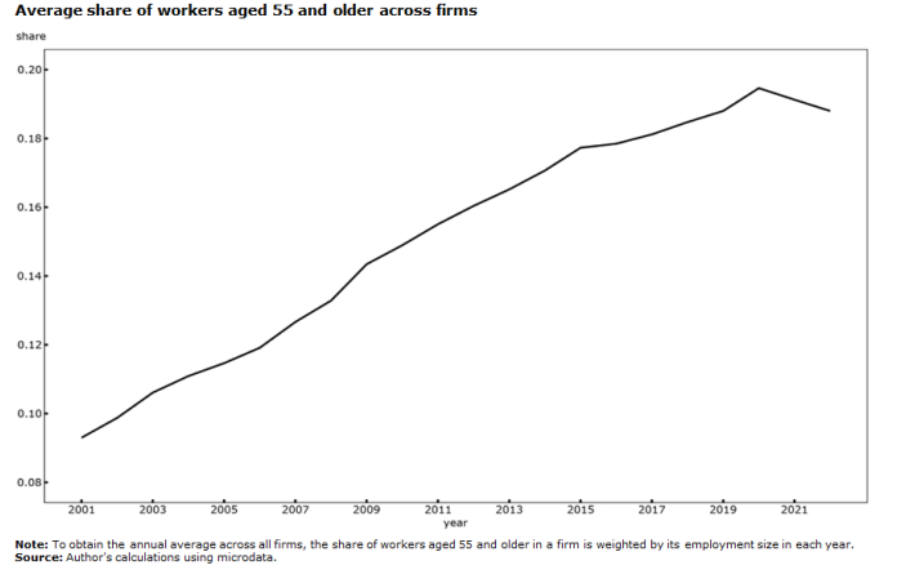
Canada’s workforce is getting older, and the shift is now showing up clearly inside Canadian businesses. New Statistics Canada data shows that the average share of workers aged 55 and older across firms has doubled over the past two decades, rising from 9.3% in 2001 to 18.8% in 2022. Put simply, the typical firm has moved from having roughly 1 in 10 workers aged 55 or older to nearly 2 in 10.
 Source: Statistics Canada
This matters because demographics are one of the slow-moving forces that shape the economy over time. An older workforce can bring experience, judgment, and institutional knowledge, which are valuable in complex business environments. It also raises important questions around succession planning, productivity, technology adoption, retirement readiness, and the availability of younger workers to fill key roles in the years ahead.
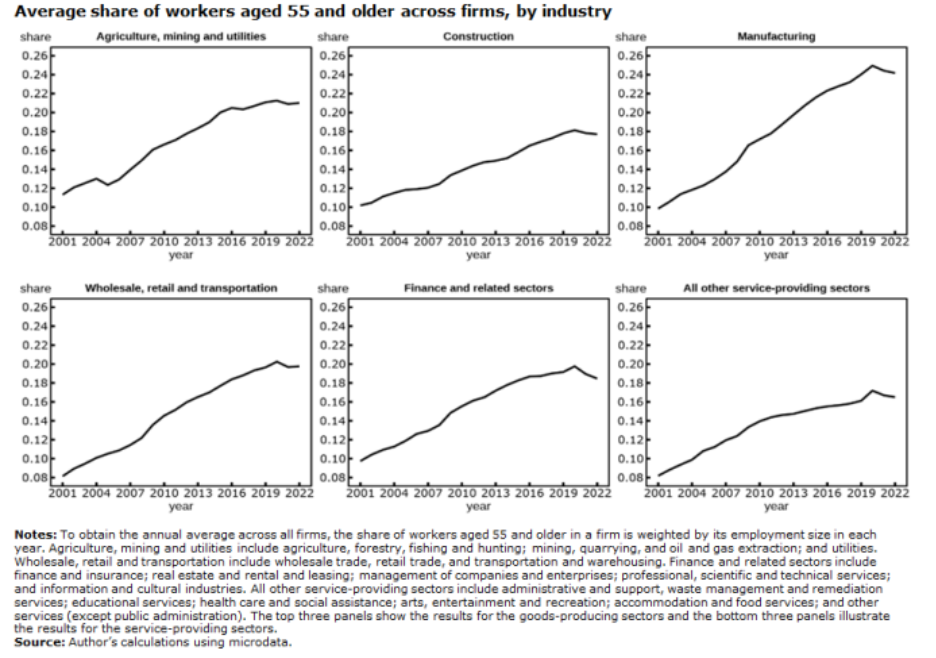
The industry breakdown shows that workforce aging is affecting some parts of the economy more than others. Manufacturing has seen the largest increase, with the share of workers aged 55 and older rising from 9.8% in 2001 to 24.2% in 2022. By 2022, nearly 1 in 4 manufacturing workers were aged 55 or older. Construction saw a smaller increase, rising from 10.2% to 17.7%, reflecting the different physical demands and career patterns across industries.
 Source: Statistics Canada
For investors, the takeaway is that Canada’s aging workforce is more than a labour market story. It affects how businesses plan, invest, train, automate, and compete. Companies that can retain experienced workers, transfer knowledge effectively, and use technology to support productivity may be better positioned as demographic pressures continue to build.
Sources: Yahoo Finance, Trading View, Statistics Canada, First Trust, Data Watch, Reuters
©2026 Milestone Wealth Management Ltd. All rights reserved.
DISCLAIMER: Investing in equities is not guaranteed, values change frequently, and past results are not necessarily an indicator of future performance. Investors cannot invest directly in an index. Index returns do not reflect any fees, expenses, or sales charges. Opinions and estimates are written as of the date of this report and may change without notice. Any commentaries, reports or other content are provided for your information only and are not considered investment advice. Readers should not act on this information without first consulting Milestone, their investment advisor, tax advisor, financial planner, or lawyer. This communication is intended for Canadian residents only and does not constitute as an offer or solicitation by anyone in any jurisdiction in which such an offer is not allowed.