Market Insights: First Quarter Wrap-up
Milestone Wealth Management Ltd. - Apr 01, 2026

2026 First Quarter Wrap-up
Key Updates on the Economy & Markets
The first quarter was eventful for markets. Stocks traded higher to start the year, with global equities posting modest gains in January and February. However, the markets traded lower in March due to escalating geopolitical tensions in the Middle East and the Strait of Hormuz closure, which led to a spike in oil prices. With the strength of energy prices, our resource-heavy S&P/TSX Composite advanced 3.94% in the quarter while the S&P 500 Index (USD) fell by 4.33% on a total return basis, making for very mixed results. Despite the late-quarter volatility, there were bright spots. The average S&P 500 stock outperformed the broad index by nearly 5% as market leadership broadened, and manufacturing data showed signs of improvement. In addition, the Canadian stock market continued its run of outperforming the US. In this letter, we recap the key developments from Q1, discuss how higher oil prices impacted rate cut expectations, highlight how diversification benefited investors, and look ahead to Q2.
Higher Oil Prices Impact Rate Cut Expectations
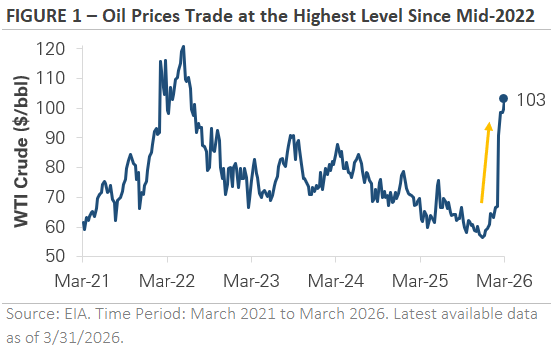
Oil prices rose in Q1 as geopolitical tensions escalated over the course of the quarter. In January, crude oil gained nearly 13% due to supply concerns related to Venezuelan output and Middle East tensions. Prices rose another 4% in February as geopolitical tensions continued to build, followed by a sharp escalation in March. The U.S.-Iran conflict and the closure of the Strait of Hormuz, a chokepoint for roughly 20% of global oil flows, sent crude oil prices surging nearly 50% in a single month. The price of oil rose more than 70% in Q1, with Figure 1 showing oil trading at the highest level since mid-2022.
The rise in oil prices matters due to its connection to inflation and central bank policy. Higher energy costs can feed into the prices that consumers and businesses pay, and the average price of a liter of regular gasoline here has already risen 51 cents since late February (and about $1 per gallon in the US). Rising oil prices are particularly relevant right now because inflation was already firming before the conflict. The U.S. Federal Reserve's (Fed) preferred inflation measure, the Core Personal Consumption Expenditures (PCE) Index, remains near 3%, and producer-level price inflation has been rising in recent months.
The combination of rising oil prices and the risk of renewed inflation pressure led to a shift in rate cut expectations. At the start of 2026, the market expected the Fed to cut rates two to three times by year end. However, the forecast changed as the market steadily priced out rate cuts during the quarter. Those rate cuts were completely removed by the end of the quarter, with the possibility of a rate hike being discussed as oil prices spiked in March.
The situation remains fluid heading into Q2. As of quarter-end, the Strait of Hormuz is still closed, and negotiations are ongoing. Oil trades near $100 per barrel, an indication that the market expects the disruption to continue. The April and May inflation data will be among the first reports to capture the impact of higher energy prices, and the market will be searching for clarity around inflation outlook and interest rate policy. While the market waits for more data, headlines and developments in the Middle East will likely impact how stocks and bonds trade in early Q2.
Investors Benefited from Diversification in Q1
One of the quarter's most significant developments was the performance gap across different areas of the U.S. stock market. While the S&P 500 had a large negative return, diversified portfolios fared differently. Figure 2 compares three ways to measure the U.S. stock market. The S&P 500 weights companies by market value, meaning the largest companies have the most influence on the index's return. The equal-weight S&P 500 assigns the same weight to each company, making it a proxy for the average stock's return. The Russell 2000 tracks an index of small-cap stocks, and the Nasdaq 100 tracks an index of leading tech companies.
The chart shows a significant gap across company size. The Russell 2000 and equal-weight S&P 500 each gained nearly 1% in Q1, outperforming the S&P 500's 4.3% decline, an indication that smaller companies outperformed in Q1. The Nasdaq 100 returned 5.8% for the full quarter. Investors with diversified exposure across company sizes, styles, and geographies experienced a more moderate quarter than the S&P 500 return suggests.
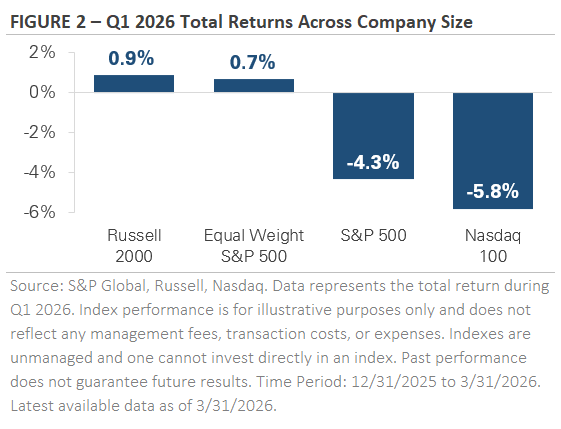
The gap shows a clear shift in market leadership in early 2026, with multiple catalysts driving the market rotation. In January, investors started moving away from the concentrated mega-cap tech trade that dominated the past two years, and the average stock quietly outperformed the index. The rotation accelerated in February as concerns about disruption from artificial intelligence spread across the market, particularly among software companies that make up a large portion of growth-style indexes. The March market volatility narrowed the performance gap, but it didn’t reverse it.
The result was a quarter in which market leadership shifted dramatically. The companies and sectors that led the market in recent years weren’t the ones that outperformed in Q1. The market rotation showed the benefit of diversification. It didn’t eliminate market volatility, but it helped manage it by spreading exposure across different areas of the market.
In addition, our Canadian markets provided further diversification with the strength of the energy sector this quarter, as well continued strength from the materials sector after outsized returns last year.
Manufacturing Data & Concerns of AI Disruption
Two competing themes in the U.S. stood out during the quarter, both of which contributed to their rotation. The first theme was related to manufacturing activity. The top section in Figure 3 on the next page graphs the ISM Manufacturing Index, which surveys purchasing managers at U.S. factories to gauge whether the sector is expanding or contracting. A reading above 50 signals expansion, while a reading below 50 signals contraction. After spending nearly a year below 50, the index crossed into expansion in February and held that level in March. The rise above 50 suggests the manufacturing sector, which has been a soft spot in the economy since 2022, was gaining traction before the conflict. Equity markets reflected that shift, with the Industrials sector setting a new all-time high in late February.
The economic data released in Q1 primarily covered activity through February, before the conflict and surge in oil prices. The data suggest the manufacturing sector entered the conflict with underlying momentum, which could cushion the impact. The March stock market sell-off reflected expectations about the potential impact of higher oil prices on future conditions rather than current weakness. Incoming data over the next several months will start to measure the real economic impact, and markets will be looking for clarity on the future outlook.
The second theme was related to artificial intelligence (AI). For the past two years, AI has been seen as a productivity tool to help existing companies do more with less. However, multiple product launches in January and February changed the way investors view AI. The market started to price AI as a potential replacement for entire categories of professional services, not just a tool to make companies more efficient.
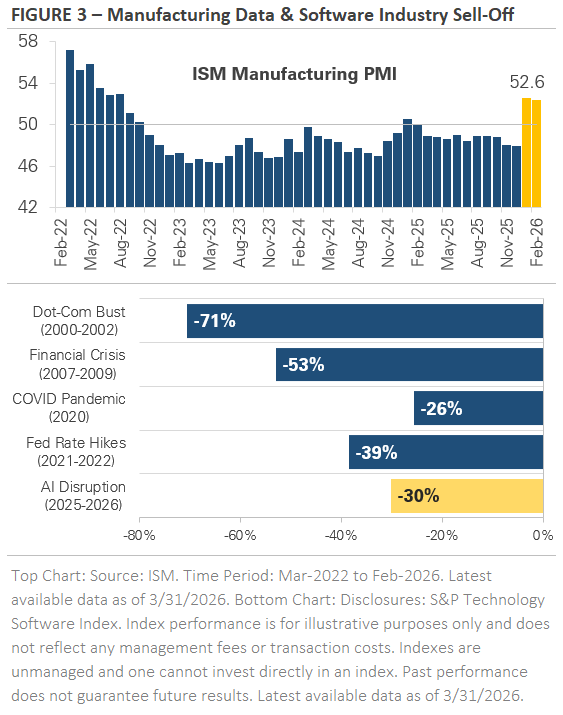
The software industry was hit particularly hard and has declined nearly -30% from its peak last October, one of the largest non-recessionary drawdowns in over 30 years. The bottom chart in Figure 3 puts the decline in historical context alongside the other major software selloffs. The two largest drawdowns before the current one, the dotcom bust and the 2008 financial crisis, both occurred during recessions when corporate earnings were declining and businesses were cutting spending. The 2022 sell-off, which was driven by the Fed’s aggressive rate-hiking cycle, was the first major non-recessionary decline and saw software stocks fall nearly 40%. The current drawdown, at nearly 30%, surpasses the COVID pandemic. The broader question of how AI will reshape professional services and the enterprise software industry is far from resolved, and its effects may continue to surface across the market as AI tools evolve.
Equity Market Recap – Looking Beyond the Index
The S&P 500 Total Return declined 4.3% in Q1, ending its three-quarter winning streak. The decline was concentrated in March, while January was modestly positive and February was flat. As discussed earlier, company size impacted returns. The largest companies, particularly those in the technology sector, drove the index-level decline. The Nasdaq, which has exposure to many of the leading mega-cap tech companies, declined nearly 6%. The sell-off weighed on growth stocks, which declined almost 10%, while Value gained 2.1%. Value outperformed Growth in each month, a level of consistency that is notable regardless of the market environment. Small-cap stocks held up better despite the volatility, with the Russell 2000 Index gaining nearly 1%. For Canada, while our equity market also had a large decline in March, a very positive February resulted in a relatively strong 3.94% total return for the quarter.
Shifting focus outside North America, international markets also outperformed the U.S. for a second consecutive quarter, with a strong January and February, while March proved more challenging as international stocks declined dramatically alongside U.S. stocks. Emerging markets had a return of -0.17% (USD) for the full quarter, with relative strength in Latin America tied to rising energy prices. Developed markets had a -1.24% return, with Europe and Asia under pressure due to their reliance on energy imports from the Middle East. From a CAD perspective, these markets returned 1.64% and 0.55% respectively, helped by a falling Loonie.
Credit Recap – Bonds Navigate a Volatile Quarter
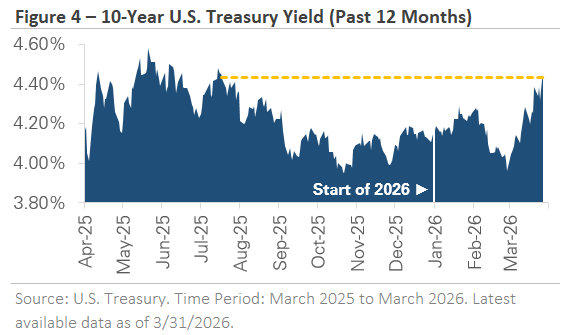
The bond market also experienced a volatile quarter as Treasury yields reacted to the changing landscape. Figure 4 graphs the 10-year U.S. Treasury yield in Q1. Interest rates rose in January as the administration issued another round of tariff threats, while February and March were nearly mirror images. Yields fell sharply in February as concerns about AI disruption caused stocks to trade lower, followed by a sharp reversal higher in March as oil prices spiked and the probability of rate cuts declined. The 10-year yield ended the quarter at 4.31% (up 0.17% YTD), the highest since June 2025, after briefly touching 4.45% in late March. The Government of Canada 10-year Bond yield closed at 3.47%, up just 0.04% in Q1, but also experienced some volatility along the way with a 0.45% gap from the low to high yield for the quarter, with most of that rise in March. Overall, the yield curve in North American remains positively steep.
The rise in interest rates weighed on bond returns. The Bloomberg U.S. Aggregate Bond Index was flat in Q1, and the S&P Canada Aggregate Bond Index rose 0.22%, after a strong 2025. Corporate bonds modestly underperformed higher-quality bonds like U.S. Treasuries due to their credit risk exposure. Credit spreads, which measure the difference in yield between corporate and government bonds, widened during the quarter. The high yield spread widened to its highest level since early 2025, reflecting increased caution among investors and uncertainty about the impact of higher energy prices on the economy and corporate earnings. However, despite the recent widening, corporate credit spreads remain well below levels reached during past recessions and financial crises. The bond market is pricing in caution, but it’s not signaling credit stress.
2026 Outlook – What to Watch in Q2
The key development to watch heading into Q2 is the situation in the Middle East and its impact on oil prices. The Strait of Hormuz was still closed at quarter-end with negotiations ongoing. Progress toward a resolution would likely ease energy costs and reduce inflation pressures, giving the Federal Reserve more flexibility on interest rate policy. A prolonged disruption would give higher oil prices more time to work their way through to the economy, potentially affecting consumer spending and business investment while keeping inflation elevated.
The connection between oil prices, inflation, and central bank policy is the thread that tied the quarter together. Higher oil prices contributed to the shift in rate cut expectations, and the upcoming April and May inflation data will be the first reports to capture the full impact of higher energy costs. How those readings come in will shape the outlook for interest rates and the broader economy.
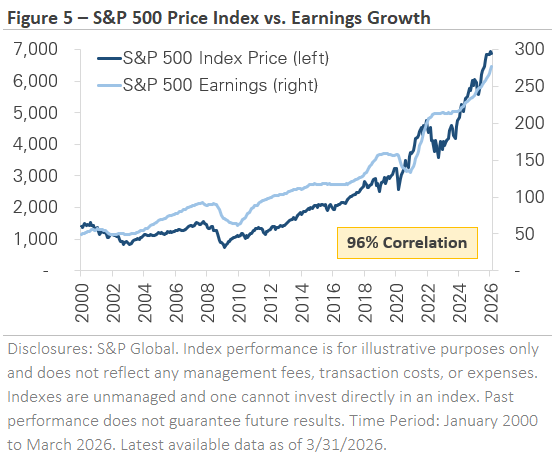
While the market's decline in Q1 drew attention, it's worth stepping back to look at the bigger picture and what’s most important for equity returns. Figure 5 shows the relationship between the S&P 500's price and its earnings over the past 26 years. The two have moved together with a 96% correlation. When earnings rise, stock prices generally follow. When earnings decline, as they did during the 2001 recession, the 2008 financial crisis, and the 2020 pandemic, stock prices tend to fall. What stands out about the current environment is that earnings estimates have continued to rise even as the S&P 500 has pulled back. Analysts still expect earnings growth in the coming quarters, and profit margins remain healthy. The market's decline has been driven by uncertainty around oil prices, inflation, and Fed policy, not by a deterioration in the fundamentals that drive stock prices over time. That distinction is important for long-term investors.
The first quarter also reinforced the importance of portfolio diversification. The areas of the market that led over the past two years underperformed in Q1. Investors with broad exposure across various asset classes, company sizes, investment styles, sectors, and geographies generally experienced a better return than the S&P 500. Staying invested through periods of market volatility, maintaining portfolio diversification, and keeping a long-term perspective remains one of the most effective approaches for building wealth.
Thank you for your continued trust in Milestone and for the opportunity to assist you in working toward your financial goals. We understand the risks and opportunities facing the markets and the economy and are committed to helping you effectively navigate all investment environments by maintaining a globally diversified portfolio designed to weather the market’s swings, aligned with your long-term goals. Market volatility can be unsettling, but it’s a normal part of investing. Therefore, it’s critical to stay invested, remain patient, and stick to the plan, as we’ve collaborated with you to establish a unique, personal allocation target based on your financial position, risk tolerance, and investment timeline.
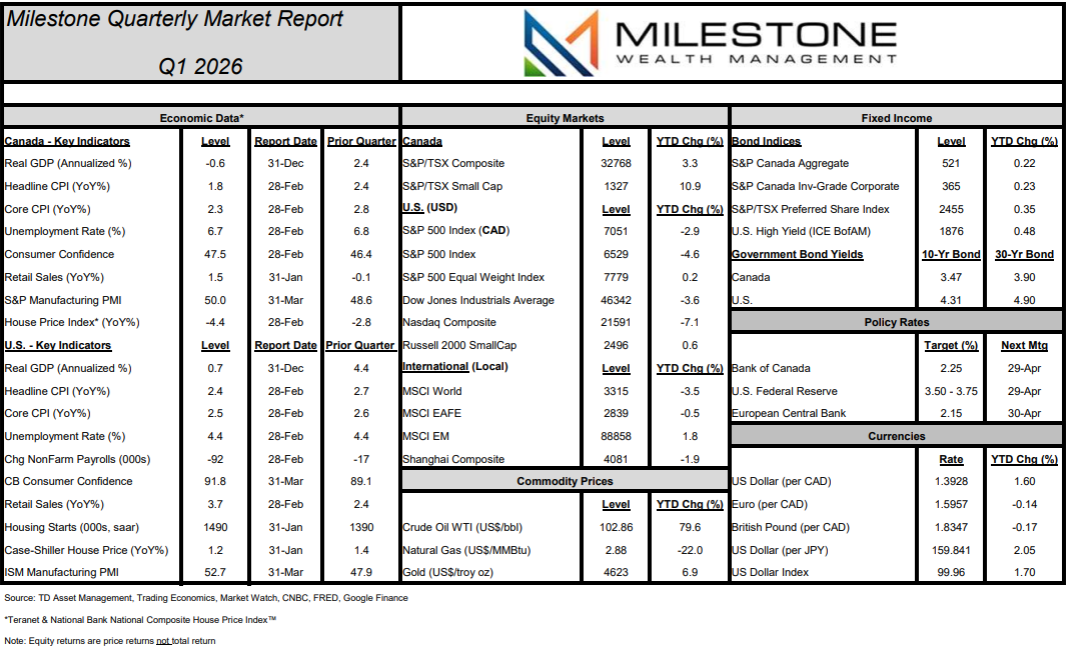
Here is our Milestone Quarterly Market Report on economic data, capital markets, commodities, and currencies through March 31st, 2026: *Click here for PDF version*
 Disclosure: Investing in equities is not guaranteed, values change frequently, and past performance is not necessarily an indicator of future performance. Investors cannot invest directly in an index. Index returns do not reflect any fees, expenses, or sales charges. Opinions and estimates are written as of the date of this report and may change without notice. Any commentaries, reports or other content are provided for your information only and are not considered investment advice. Readers should not act on this information without first consulting Milestone, their investment advisor, tax advisor, financial planner, or lawyer. This communication is intended for Canadian residents only and does not constitute as an offer or solicitation by anyone in any jurisdiction in which such an offer is not allowed.
Sources: Bloomberg, Barchart, TD Asset Management, Trading Economics, Teranet & National Bank of Canada, Barchart, MarketDesk Research LLC, S&P Global, Russell Indices, MSCI, U.S. Department of Labor, U.S. Federal Reserve, U.S. Census Bureau, NAHB & U.S. Bureau of Economic Analysis ©2026 Milestone Wealth Management Ltd. All rights reserved.