Market Insights: Strong Earnings but a More Cautious Market
Milestone Wealth Management Ltd. - Nov 13, 2026
Steve Nielsen, B.Comm, CFP®, CIM®, Chief Investment Officer. Week ending November 13, 2026.
Three Things to Know
U.S. Inflation
CPI rose to 4.1% and wholesale prices hit 6.5%, a near four-year high, strengthening the case for a December Fed hike.
NVIDIA Leadership
Jensen Huang resigned after 33 years as CEO, with CFO Colette Kress named interim CEO ahead of November 17 earnings.
Earnings vs. Valuations
Q3 S&P 500 earnings grew 31.4%, yet the forward P/E has fallen from 22.0 to 17.7, its lowest since November 2023.
The Week at a Glance
S&P/TSX Composite
+0.86%
on the week
S&P 500
+2.36%
on the week
Dow Jones Industrial
1.97%
on the week
Canadian Dollar
¢70.09
vs. ¢70.83 USD
WTI Crude
$88.77
vs. $90.56 USD
Gold
$3,879
vs. $4,075 USD
Recent Insights
Macroeconomic & Market Developments
- U.S. producer prices rose 0.3% in October, slightly below expectations of 0.4%, while annual wholesale inflation climbed to 6.5%, its highest level in nearly four years. Underlying inflation remained elevated, with core PPI, excluding food and energy, increasing 0.5% for the month and 5.0% year-over-year, reflecting persistent cost pressures across the economy. Goods prices have surged 10.2% over the past year, driven partly by higher energy costs and strong demand for AI-related infrastructure, while gasoline and diesel prices have increased 75.9% and 115%, respectively. Further up the supply chain, processed intermediate goods prices are up 14.6% year-over-year, suggesting businesses continue to face substantial input cost pressures. The report reinforces concerns that elevated production costs could eventually be passed on to consumers, strengthening the case for another Federal Reserve interest rate hike in December.
- U.S. consumer prices rose 0.4% in October, exceeding expectations of 0.3% and pushing annual inflation to 4.1%, as persistent price pressures continued to weigh on households. Energy prices increased 0.7% for the month and 21.5% year-over-year, while food prices rose 0.5%, their largest monthly increase in six months. Underlying inflation also remained elevated, with core CPI rising 0.3% for the third consecutive month and 2.8% annually, driven partly by higher housing, transportation and service costs. Meanwhile, inflation-adjusted hourly earnings declined 0.8% year-over-year, highlighting continued pressure on consumer purchasing power.
- U.S. authorities and private-sector partners have frozen more than $2.7 billion in cryptocurrency following the $6.3 billion Binance hack on October 29, which federal investigators have attributed to North Korea’s TraderTraitor hacking group. The Department of Justice has obtained court authorization to seize or restrain more than $1.2 billion of the frozen assets, while efforts continue to trace and recover the remaining stolen funds. Binance has also announced that it has fully replenished affected customer assets using company resources, maintaining that users will not bear any financial losses from the breach. Investigators believe the attack originated through a compromised employee computer, allowing hackers to exploit internal systems and authorize fraudulent transactions.
- Canada’s annual inflation rate of 3.1% in September masks significant regional disparities, with eight of ten provinces experiencing inflation above 3%. Provincial rates ranged from 2.5% in Ontario to 5.7% in Prince Edward Island, largely reflecting the uneven impact of rising energy prices. Atlantic Canada has been particularly affected due to its greater reliance on heating oil and higher energy costs, while rent increases exceeding 6% across Atlantic provinces have added further pressure on households. Alberta has also faced unique challenges, with automobile insurance premiums rising approximately 23% year-over-year, significantly outpacing the national average. Meanwhile, wage growth has failed to keep pace with inflation in most provinces, reducing household purchasing power. These regional differences complicate the Bank of Canada’s interest rate decisions, as further tightening could help contain inflation in higher-cost regions while placing additional pressure on weaker economies such as Ontario and British Columbia.
- NVIDIA announced that co-founder and longtime CEO Jensen Huang has resigned from his positions as President, CEO and board member, effective immediately, ending his 33-year leadership of the AI chipmaker. The company appointed Colette Kress, its Chief Financial Officer since 2013, as Interim CEO, while the board begins searching for a permanent successor from both internal and external candidates. Longtime director Harvey C. Jones has also been appointed NVIDIA’s first-ever independent Board Chair. The unexpected departure marks a significant leadership transition for one of the world’s most influential technology companies, raising questions about the continuity of NVIDIA’s AI strategy and future growth. While management has emphasized that operations and product development will continue uninterrupted, investors will be closely watching the company’s November 17 earnings report for reassurance about its direction under new leadership.
Charts of the Week
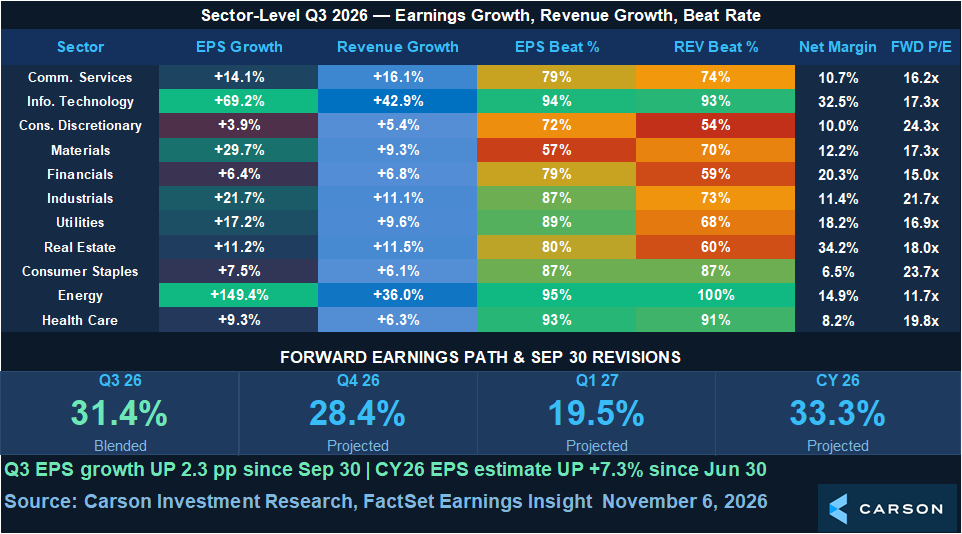
Third-quarter earnings season has been very strong overall, but the gains have not been evenly distributed across the market. According to Carson Group’s November 10th analysis, with 88% of S&P 500 companies having reported in the U.S., blended earnings growth rose to 31.4%, while revenue growth came in at 14.3%. The last three quarters have represented some of the fastest profit expansion seen outside of immediate post-recession economic rebounds. Sector results show that Energy and Technology have been the main drivers of this past quarter’s strength, while Communication Services has been one of the few areas to slow relative to expectations. That tells us the earnings story is positive, but also somewhat concentrated.
Source: Carson Group, FactSet
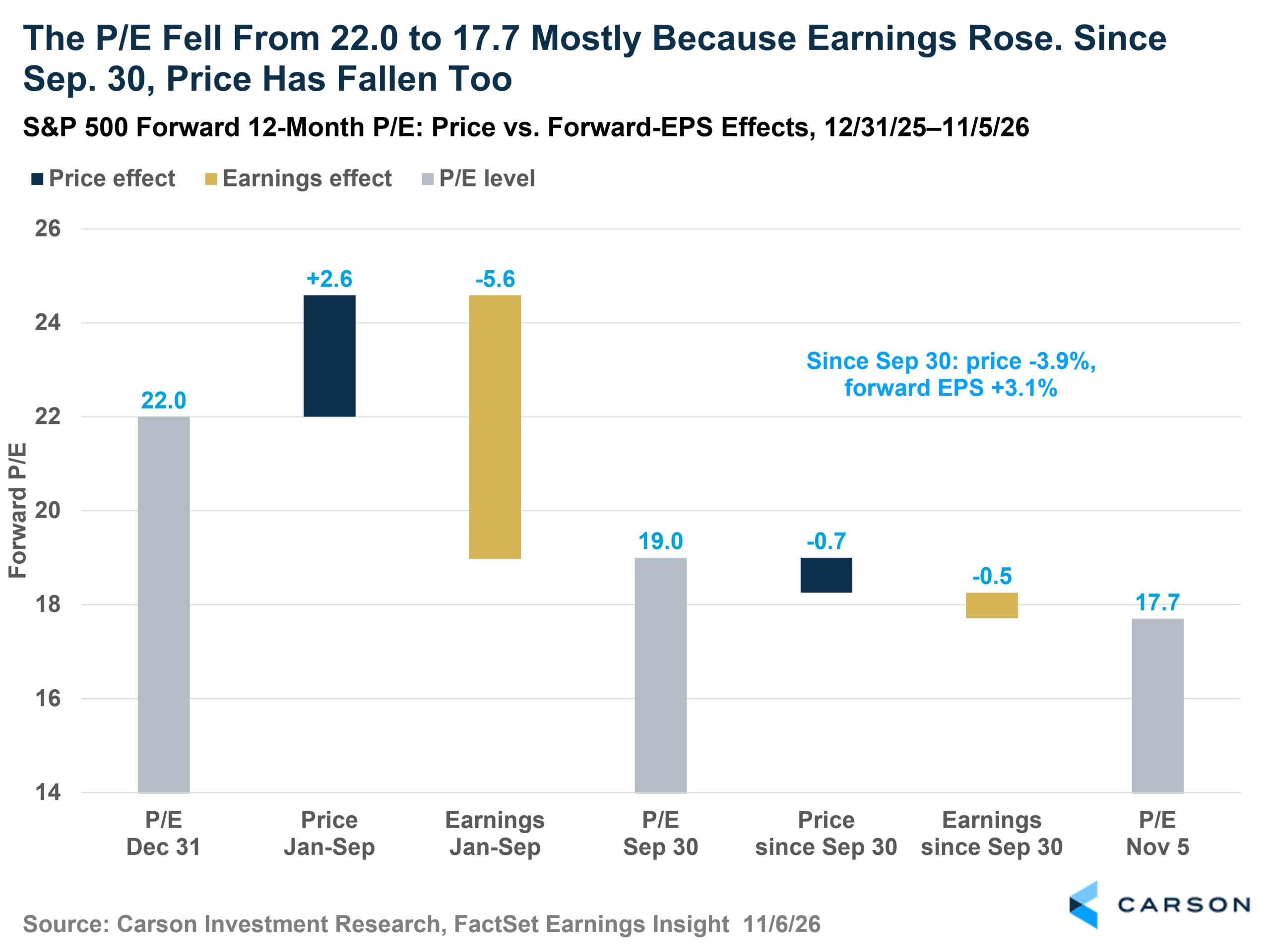
Even with earnings coming in strongly, investors have been paying less for those profits. Carson notes that the S&P 500’s forward price-to-earnings (P/E) ratio, which measures how much investors are willing to pay for each dollar of expected earnings, fell from 22.0 at the start of the year to 17.7, its lowest level since November 2023. For most of this year, that decline was driven by a healthy dynamic: earnings were rising faster than stock prices. More recently, however, earnings estimates have continued to move higher while the market has pulled back, suggesting investors have become less confident that this level of profitability can last. However, current valuations provide a much better support now than they did a year ago in the event of a cyclical peak in earnings growth.
Source: Carson Group, FactSet
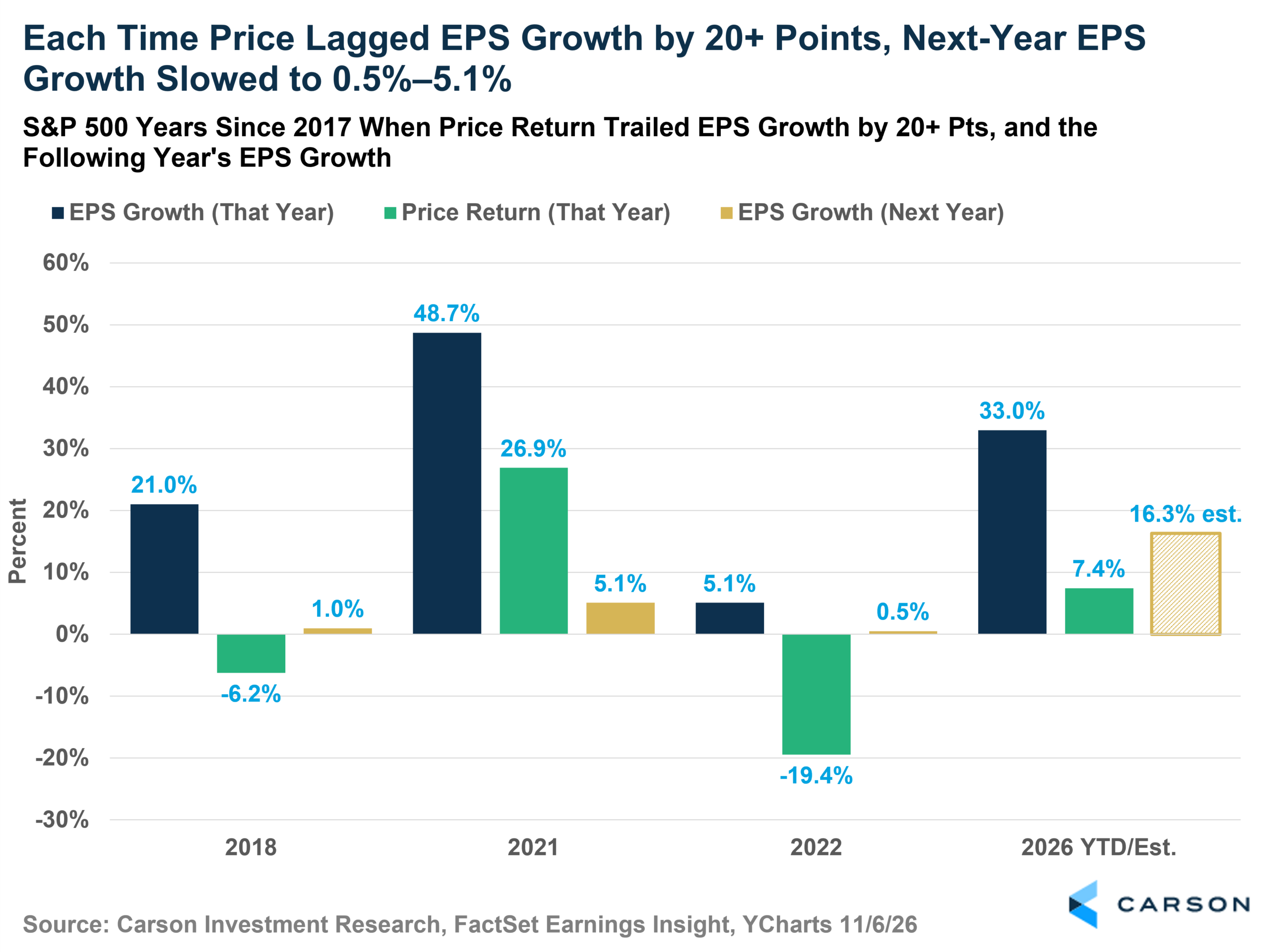
That caution becomes more interesting when viewed in a historical context. They point out that the S&P 500 earnings are on track to grow about 33% this year, while the index itself is up just 7.4%. Since 2017, there have only been three other years when price performance lagged earnings growth by at least 20 percentage points. In each of those cases, earnings growth slowed sharply the following year. While this is a small sample, it suggests the market may be looking past today’s strong profits and focusing instead on whether they represent a cyclical peak.
Source: Carson Group, FactSet
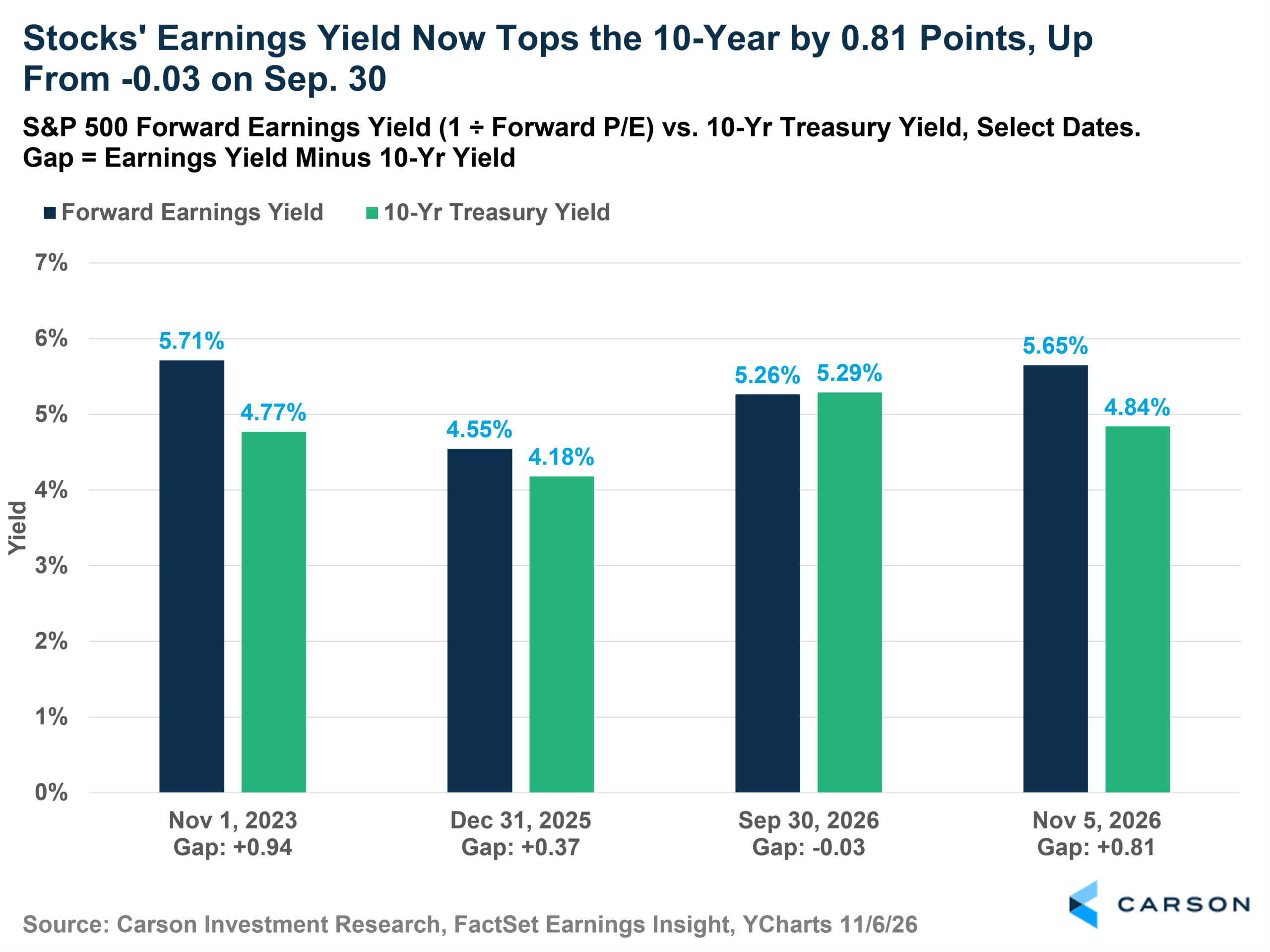
At the same time, lower valuations may be making stocks more attractive relative to bonds. At a forward P/E of 17.7, the S&P 500’s earnings yield is about 5.65%, compared with a 4.84% yield on the 10-year U.S. Treasury (5.1% as of today). In other words, stocks are now offering a higher implied earnings return than bonds, which was not the case at the end of September. If earnings remain resilient, that relative valuation could support equities from current levels.
Source: Carson Group, FactSet
What This Means for Investors
For investors, the takeaway is that the current market backdrop is mixed. Earnings have been very strong, particularly in Energy and Technology, but investors appear hesitant to fully reward those results. That may reflect concerns that some of this profit strength is unusually high and could moderate in 2027. On the other hand, lower valuations and improved relative value versus bonds may provide some support if earnings hold up better than expected. For now, the message seems to be that strong earnings alone are not enough — the market also wants confidence that they are sustainable.
Sources: Yahoo Finance, First Trust, BNN Bloomberg, Nvidia Newsroom, RBC Insights, Fox Business, Carson investment Group.
DISCLAIMER: Investing in equities is not guaranteed, values change frequently, and past results are not necessarily an indicator of future performance. Investors cannot invest directly in an index. Index returns do not reflect any fees, expenses, or sales charges. Opinions and estimates are written as of the date of this report and may change without notice. Any commentaries, reports or other content are provided for your information only and are not considered investment advice. Readers should not act on this information without first consulting Milestone, their investment advisor, tax advisor, financial planner, or lawyer. This communication is intended for Canadian residents only and does not constitute as an offer or solicitation by anyone in any jurisdiction in which such an offer is not allowed.