Market Insights: Can AI Pay Its Way? Anthropic’s Filing Offers Early Clues
Milestone Wealth Management Ltd. - Oct 30, 2026
Steve Nielsen, B.Comm, CFP®, CIM®, Chief Investment Officer. Week ending October 30, 2026.
Three Things to Know
Canada’s Economy
GDP stalled for a second month in August, and Q3 is tracking just 1.3%, well below the Bank of Canada’s 2.0% forecast.
U.S. Growth and Inflation
Q3 GDP grew 3.4% on AI investment and consumer spending, but core PCE inflation remains well above target at 3.1%.
AI Economics
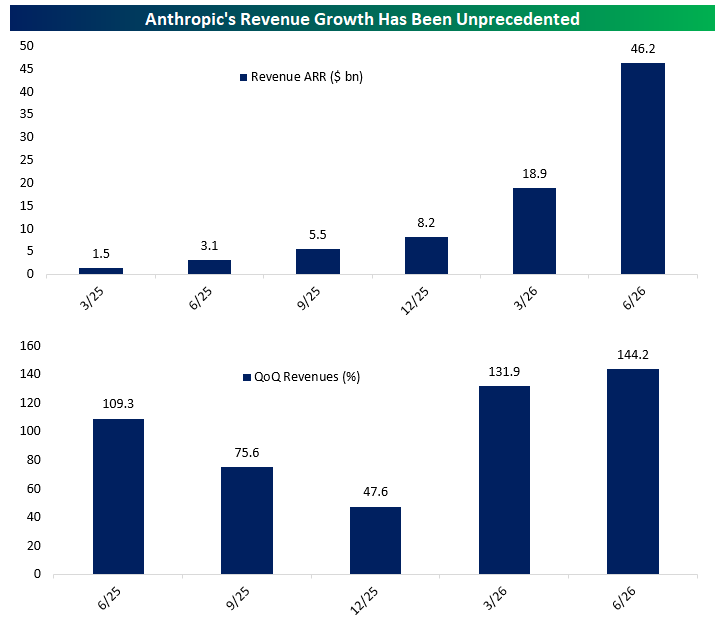
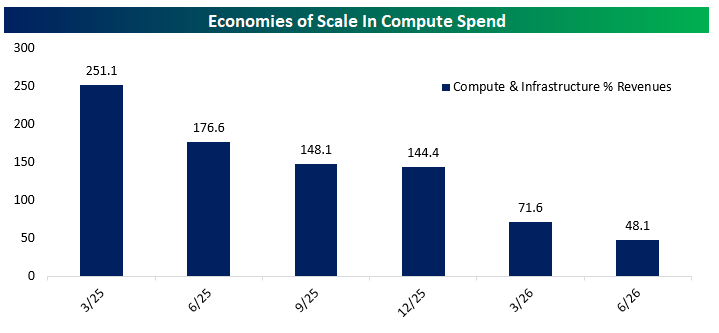
Anthropic’s annualized revenue jumped from $1.5 billion to $46.2 billion in 15 months as compute costs fell to 48% of revenue.
The Week at a Glance
S&P/TSX Composite
-0.47%
on the week
S&P 500
-1.82%
on the week
Dow Jones Industrial
-1.09%
on the week
Canadian Dollar
0.7158
71.35
WTI Crude
103.73
103.51
Gold
3,919
4,010
Recent Insights
Macroeconomic & Market Developments
- U.S. real GDP grew at a 3.4% annualized rate in the third quarter, exceeding expectations of 3.2%, supported by resilient consumer spending and continued investment in artificial intelligence infrastructure. Consumer spending increased 3.8%, while data-centre construction surged at a 127% annualized rate and business investment in information-processing equipment rose 37.3%. Underlying economic activity was particularly strong, with core GDP expanding at a 4.9% annualized pace, its fastest in over five years. However, net exports subtracted 3.3 percentage points from growth, while inventories and government spending contributed a combined 2.5 percentage points, potentially overstating the sustainability of the headline figure.
- U.S. personal income rose 0.2% in September, slightly below expectations of 0.3%, while consumer spending increased 0.5%, continuing a trend of spending growth outpacing income. However, inflation-adjusted consumer spending was unchanged, as higher prices effectively erased the increase in nominal spending. The Federal Reserve’s preferred inflation measure, the PCE price index, rose 0.5% for the month and 3.6% year-over-year, while core PCE inflation increased 0.3% monthly and 3.1% annually, remaining above the Fed’s 2% target.
- Canada’s economy stalled for the second consecutive month in August, falling short of expectations for 0.2% growth, as weakness in wholesale trade and public-sector activity offset gains elsewhere. Wholesale trade declined 1.4%, while public-sector activity contracted 0.2%, outweighing increases in retail trade (+1.2%), manufacturing (+0.3%) and construction (+0.2%). More concerning, Statistics Canada’s preliminary estimate suggests GDP contracted 0.1% in September, putting third-quarter growth on pace for just 1.3% annualized, well below the Bank of Canada’s 2.0% forecast. The disappointing data come just days after the Bank of Canada raised its benchmark interest rate by 25 basis points to 2.50%, highlighting the Canadian economy’s continued struggle to sustain growth amid ongoing trade uncertainty and weakening domestic economic activity.
- Binance, the world’s largest cryptocurrency exchange, suffered an estimated $6.3 billion cyberattack, potentially the largest cryptocurrency theft in history, with blockchain investigators linking the breach to North Korea’s TraderTraitor hacking group. The attack reportedly compromised Binance’s wallet infrastructure, allowing hackers to transfer billions in digital assets across multiple blockchains. Approximately $3 billion in affected assets have been frozen, while more than $3 billion remains potentially unrecovered. Binance temporarily suspended customer withdrawals but has pledged to cover all losses using company reserves and its customer protection fund. The incident triggered a broader cryptocurrency selloff, with Bitcoin falling toward $76,600 and shares of Coinbase, Robinhood and Strategy declining sharply. Although Binance maintains that customer funds are protected, the breach raises significant concerns about cybersecurity vulnerabilities and investor confidence in centralized cryptocurrency exchanges.
Weekly Diversion
Charts of the Week
Artificial intelligence has attracted enormous investment in recent years, but an important question remains: can AI companies turn that spending into sustainable profits? Recent financial disclosures from Anthropic (the company behind Claude), one of the leading artificial intelligence developers, provide an interesting look at how quickly the industry is evolving. According to Bespoke Investment Group's analysis of Anthropic's preliminary public offering filing earlier this week, the company has experienced extraordinary revenue growth while significantly improving its operating efficiency.
Anthropic's annualized revenue, which estimates yearly sales based on its current pace of business, increased from approximately $1.5 billion in March 2025 to $46.2 billion by June 2026. This represents an remarkable increase in just 15 months, with revenue more than doubling in each of the two most recent quarters. Total revenue growth is 1450% over 15 months ended Q2 of this year. While rapid growth in the AI industry has been widely discussed, these figures provide a clearer picture of just how quickly some businesses and consumers are adopting the technology.
Source: Bespoke Investment Group
Perhaps more importantly, Anthropic's costs are becoming much more manageable relative to its revenue. In early 2025, the company's computing and infrastructure expenses were more than twice its revenue. By June 2026, those costs had fallen to approximately 48% of revenue. This improvement suggests that as Anthropic grows, it is becoming more efficient at delivering its services. Although the company continues to invest heavily in computing infrastructure, its revenue is now growing much faster than these costs.
Source: Bespoke Investment Group
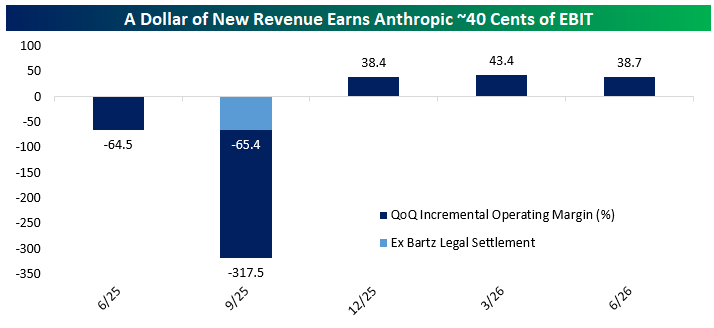
That efficiency is also showing up in the company's profitability. Over the last three quarters, Anthropic generated approximately 38 cents in additional operating profit for every new dollar of revenue. This is an encouraging development because it suggests that the company is increasingly able to translate revenue growth into earnings, rather than having additional sales absorbed entirely by rising expenses.
Source: Bespoke Investment Group
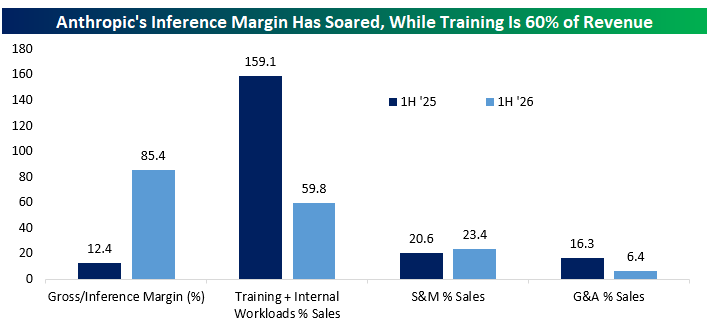
A closer look at the company's expenses reinforces this trend. Anthropic's inference margin, which measures how much revenue remains after the direct computing costs of providing its AI services, increased from 12.4% in the first half of 2025 to 85.4% in the first half of 2026. Meanwhile, spending on model training and internal computing workloads fell from approximately 159% of revenue to 60% over the same period. These improvements suggest the company is becoming more efficient as its customer base and revenue expand.
Source: Bespoke Investment Group
What This Means for Investors
For investors, the takeaway extends beyond Anthropic itself. The rapid growth and improving economics of one of the industry's leading companies suggest that demand for artificial intelligence remains strong and that the substantial investment flowing into the sector may be translating into increasingly viable businesses. However, significant computing costs, competition, and the possibility of slowing growth remain important considerations. While Anthropic's financial results offer an encouraging view of the industry's development, strong business fundamentals do not automatically make an investment attractive, particularly when the company's public offering valuation has yet to be established.
Sources: Yahoo Finance, First Trust, Financial Post, CTV, Reuters, Fox Business, Bespoke Investment Group.
Milestone Recession Risk™ Composite

As of October 23, 2026
What it is: A rules-based dashboard we use to watch for recessions and decide when to take risk off the table.
Why it matters to you: No one can predict every market dip, and we don’t try to. The Composite gives us a disciplined way to respond when the evidence points to rising recession risk, so decisions rest on data rather than headlines.
DISCLAIMER: Investing in equities is not guaranteed, values change frequently, and past results are not necessarily an indicator of future performance. Investors cannot invest directly in an index. Index returns do not reflect any fees, expenses, or sales charges. Opinions and estimates are written as of the date of this report and may change without notice. Any commentaries, reports or other content are provided for your information only and are not considered investment advice. Readers should not act on this information without first consulting Milestone, their investment advisor, tax advisor, financial planner, or lawyer. This communication is intended for Canadian residents only and does not constitute as an offer or solicitation by anyone in any jurisdiction in which such an offer is not allowed.