Market Insights: Quiet Markets Aren’t Always Weak Markets
Milestone Wealth Management Ltd. - Sep 25, 2026
Macroeconomic and Market Developments:
- North American markets were mainly up this week. In Canada, the S&P/TSX Composite Index fell by 0.02%, while in the U.S., the Dow Jones Industrial Average increased by 0.28% and the S&P 500 Index rose by 1.21%.
- The Canadian Dollar decreased again this week, closing at 70.66 vs. 71.43 cents USD last week.
- Oil prices dropped again this week, with U.S. West Texas Crude closing at US$92.54 vs. US$95.41 last week.
- The price of Gold fell this week closing at US$4,327 vs. US$4,420 last week.
- Canadian retail sales fell 0.7% in July to $73.7 billion, marking their first monthly decline since December 2025, as higher gasoline prices and broader inflationary pressures weighed on household purchasing power. Weakness was widespread, with eight of nine retail subsectors declining, including general merchandise (-1.9%), motor vehicles and parts (-0.8%), and gasoline stations (-0.9%). Headline inflation also accelerated to 3.0% in July from 2.8% in June, adding pressure to household budgets. While preliminary data point to a 1.3% rebound in retail sales in August, economists expect consumer spending growth to moderate toward year-end as elevated energy costs, trade uncertainty and softer employment conditions constrain discretionary spending.
- Atlantic Canadian business leaders are calling for the four provinces to operate more closely as a “single economy” in an effort to address decades of economic underperformance. The Atlantic Economic Panel says the region has trailed national GDP growth by roughly 1% annually for three decades, citing weak productivity, labour shortages and interprovincial barriers as key challenges. Its proposals include eliminating trade and labour mobility barriers, creating a regional investment platform and integrated electricity system, and establishing a $1 billion Atlantic Prosperity Fund. The plan also targets $100 billion in new investment, a 50% increase in the value of the region’s natural-resource economy, and doubling exports to Europe to more than $30 billion. However, the recommendations remain proposals and would require substantial investment and coordination between four provincial governments before their potential economic benefits could be realized.
- President Trump’s consideration of restrictions on U.S. diesel exports has increased the near-term profitability of shipping American diesel overseas, as concerns over future supply pushed European prices higher relative to U.S. prices. Global diesel markets are already tight following disruptions from the Iran war and continued Ukrainian attacks on Russian refineries, despite Trump publicly urging President Zelenskyy to halt the strikes due to their impact on global diesel supplies and prices. Europe’s reliance on U.S. diesel has consequently increased, and the widening transatlantic price differential has encouraged additional tanker bookings. If U.S. export restrictions are ultimately implemented, the market dynamic could shift considerably, potentially lowering domestic diesel prices while further tightening supplies for Europe and other major importers.
- Meta shares have surged more than 30% in September, putting the stock on pace for its strongest month since 2013, as enthusiasm surrounding the company’s new AI agent, Muse, has helped shift investor sentiment toward its aggressive AI investments. The rally includes a roughly 13% gain over the past week, following a volatile year in which concerns over rising AI spending and declining free cash flow repeatedly pressured the stock. Meta’s investments have carried significant costs, including more than $73 billion spent on its Reality Labs initiative over five years, but the recent response to Muse suggests investors are becoming more optimistic that the company’s substantial AI spending could translate into commercially valuable products.
Weekly Diversion:
Check out this video: I think I'd retire after a few of these bounces
Charts of the Week:
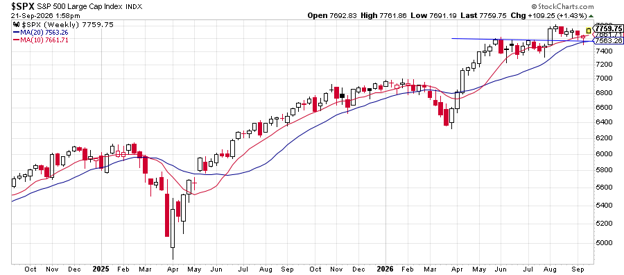
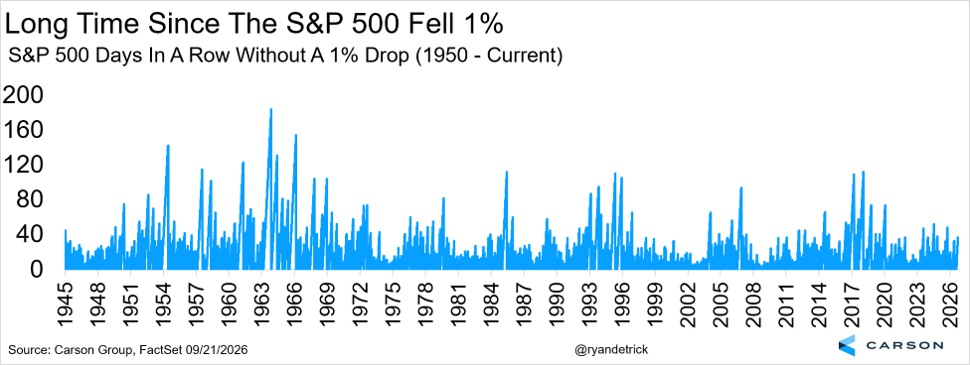
This week’s Charts of the Week focuses on a simple but important market idea: sometimes a quiet market is not a weak market. Carson Group notes that the S&P 500 has been unusually calm recently, with four straight weeks where the index did not gain or lose more than 1% for the week. The index also went 37 trading days without a daily decline of 1% or more, even though September is often viewed as a seasonally difficult month for stocks.
Source: Carson Group
One reason this matters is that the market has remained above key technical levels, including support from the early-June peak and its upward-sloping 10- and 20-week moving averages. In plain English, this means the market has been moving sideways rather than breaking down. That type of pause or consolidation can sometimes be healthy, especially after a strong advance, because it allows the market to digest gains without giving up much ground.
Source: Carson Group
The old Wall Street axiom is to “never short a dull market.” For clients, the idea is simple: when the market gets quiet, it does not automatically mean trouble is coming. Sometimes it means investors are waiting for the next catalyst while the broader trend remains intact. Carson Group also noted that the S&P 500 jumped nearly 3% in the three days following the latest Federal Reserve meeting even though they raised rates, suggesting investors viewed the policy backdrop more positively than feared.
Source: Carson Group
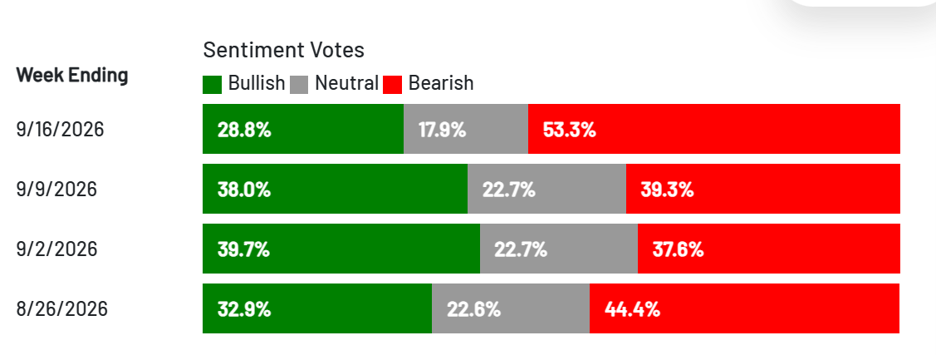
Another interesting part of the setup is investor sentiment. Even with the S&P 500 close to record highs, Carson Group highlighted that sentiment indicators have become more cautious. The CNN Fear & Greed Index was recently near “extreme fear”, while the widely followed American Association of Individual Investors (AAII) Sentiment Poll saw a large increase in bearish responses and bulls fell to their lowest level of the year. From a contrarian perspective, heavy skepticism can sometimes be supportive because it means expectations are already low.
For investors, the takeaway is that a calm market should not automatically be viewed as a negative signal. The S&P 500 has been quiet, but it has also importantly held key support levels, avoided large daily declines, and moved higher after the last Fed meeting. While short-term volatility can always return, the combination of a steady market and cautious investor sentiment suggests the backdrop may be more constructive than September’s reputation alone would imply.
Sources: Bloomberg, The Canadian Press, Yahoo Finance, The Financial Post, Reuters, Carson Investments
©2026 Milestone Wealth Management Ltd. All rights reserved.
DISCLAIMER: Investing in equities is not guaranteed, values change frequently, and past results are not necessarily an indicator of future performance. Investors cannot invest directly in an index. Index returns do not reflect any fees, expenses, or sales charges. Opinions and estimates are written as of the date of this report and may change without notice. Any commentaries, reports or other content are provided for your information only and are not considered investment advice. Readers should not act on this information without first consulting Milestone, their investment advisor, tax advisor, financial planner, or lawyer. This communication is intended for Canadian residents only and does not constitute as an offer or solicitation by anyone in any jurisdiction in which such an offer is not allowed.