Market Insights: Market Breadth Shows Some Cracks
Milestone Wealth Management Ltd. - Sep 18, 2026
Macroeconomic and Market Developments:
- North American markets were mixed this week. In Canada, the S&P/TSX Composite Index rose 0.31%, while in the U.S., the Dow Jones Industrial Average decreased by 1.69% and the S&P 500 Index fell by 0.08%.
- The Canadian Dollar decreased again this week, closing at 71.43 vs. 72.09 cents USD last week.
- Oil prices dropped this week, with U.S. West Texas Crude closing at US$95.41 vs. US$100.07 last week.
- The price of Gold rose this week closing at US$4,420 vs. US$4,389 last week.
- U.S. retail sales increased 1.2% in August, beating expectations of 0.8% and rebounding strongly from July as consumer spending remained resilient. The increase was broad-based, with 11 of 12 major categories posting gains, led by non-store retailers (+2.6%), gasoline stations (+3.1%), and restaurants & bars (+1.2%). Core retail sales, which exclude autos, building materials, and gasoline, rose a strong 1.3% and are on pace for a 4.8% annualized increase in Q3 versus the Q2 average. Overall retail sales are now 6.0% higher year-over-year, or 2.6% after adjusting for inflation, supporting continued economic growth heading into the final months of 2026.
- The Federal Reserve raised its benchmark interest rate by 25 basis points to 3.75%–4.00%, marking its first-rate hike since mid-2023 as policymakers shift their focus toward persistent inflation and resilient domestic spending. Fed Chair Warsh emphasized the strength of the U.S. economy and said inflation has remained too high for too long, while the updated dot plot signals another 25-basis-point hike later this year, with 12 of 18 policymakers projecting one additional increase. The Fed’s longer-term projections remain relatively measured, showing no hikes in 2027 and one cut in both 2028 and 2029.
- Prime Minister Mark Carney welcomed a proposal for Canada to become the European Union’s first “associate member,” although what that designation would actually entail remains largely undefined. Canada and the EU have outlined ambitions for closer cooperation in areas including defence, energy, critical minerals, AI and financial services, but no agreement currently guarantees Canada greater access to these sectors, nor have the potential financial contributions, regulatory obligations or other commitments required from Canada been established. With Canada already enjoying significant European market access through CETA, the economic implications of a deeper relationship will ultimately depend on the terms negotiated, making both the potential benefits and costs highly uncertain at this stage.
- CPP Investments and Brookfield Asset Management have launched a new $50 billion “Maple Fund” aimed at financing major infrastructure and strategic industry projects across Canada. The two organizations will invest on a 50-50 basis, each committing up to $25 billion in equity over the next five years, provided projects meet their respective investment criteria. While the fund could provide significant private capital for Canadian projects, the ultimate deployment of the $50 billion will depend on whether sufficiently attractive opportunities can meet the investors’ required returns.
- Warren Buffett has stepped down as Chairman of Berkshire Hathaway at age 96, completing the final stage of a carefully planned leadership transition after more than six decades at the company. His son Howard Buffett, a Berkshire director since 1993, will become non-executive Chairman and focus primarily on preserving the company’s culture and values, while Greg Abel will continue running Berkshire as CEO. Warren Buffett will remain on the board as Chairman Emeritus and continue providing his perspective. The transition formally moves the roughly $1.1 trillion conglomerate into its post-Buffett era, putting increased attention on whether Berkshire can maintain the decentralized management structure, disciplined capital allocation and long-term investment philosophy that defined Buffett’s tenure.
Weekly Diversion:
Check out this video: Still podium, but a disappointing demotion
Charts of the Week:
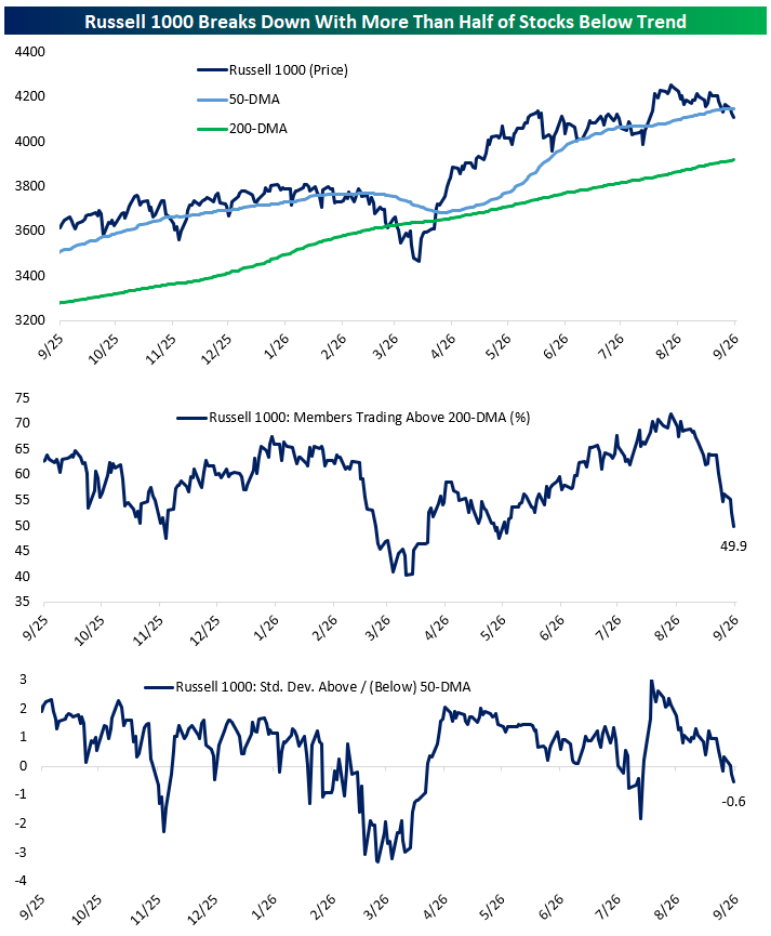
This week, we are highlighting a market signal that points to some weakness beneath the surface of U.S. equities. While the major indexes have only pulled back modestly from recent highs, the broader Russell 1000 Index is showing that more individual stocks are losing momentum.
A simple way to think about this is by looking at a stock’s 200-day moving average, which is just its average price over the last 200 trading days. When a stock is above that level, it is generally considered to be in a longer-term uptrend. When it falls below that level, it can be a sign that its trend is weakening.
Source: Bespoke Investment Group
At the recent close, fewer than half of Russell 1000 stocks were trading above their 200-day moving average. In other words, more than half of the stocks in the index had fallen below their longer-term trend line. That is notable because earlier in August, more than 70% of Russell 1000 stocks were still above that level. The index itself has not fallen dramatically, but underneath the surface, participation has weakened.
This matters because a healthy market is usually supported by a broad group of stocks moving higher together. When fewer stocks are participating, the market can become more dependent on a smaller group of leaders. That does not mean a major decline will occur, but it does suggest that the current pullback may not yet fully reflect investor caution.
Source: Bespoke Investment Group
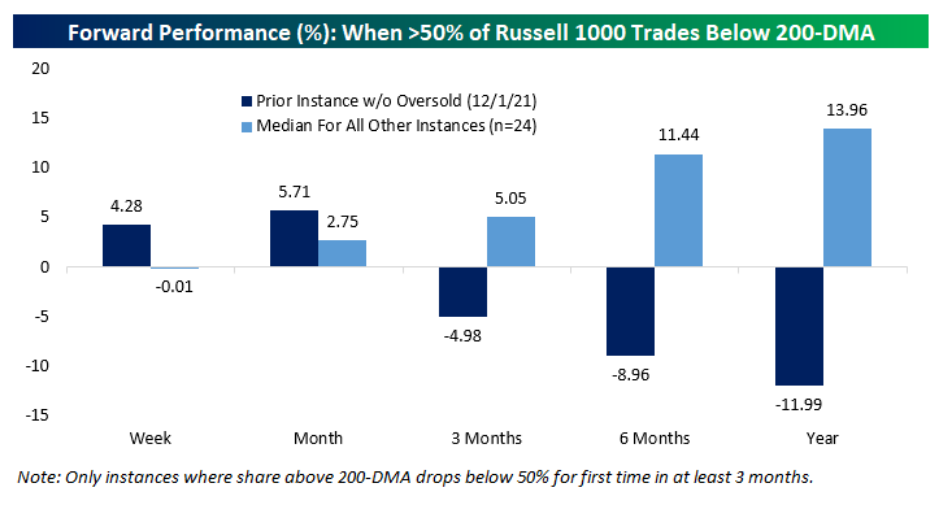
Historically, when more than half of Russell 1000 stocks fell below their 200-day moving average, it often happened after the index was already deeply oversold. In those cases, the weakness frequently created a better buying opportunity, and forward returns were generally positive.
The current setup is different. This time, breadth has weakened even though the index itself is still within a normal range of its shorter-term trend (less than 1% standard deviation below its 50-day moving average). Since 1995, there has only been one similar example: December 2021. In that instance, the Russell 1000 was up over the next week and month but later declined by roughly 5%, 9% and 12% over the next three, six and twelve months. However, this is only a sample of one, so the significance of this period compared to today is likely not overly relevant, but still worthy of some caution. The best defence against any short-term drawdowns is diversification across asset classes, strategies/styles, geographies, and privates.
For investors, the takeaway is that the U.S. market’s headline performance may be masking some weakness underneath. The index has not experienced a major decline, but a growing number of individual stocks have already slipped below longer-term trend levels. That makes this a signal worth watching. It does not mean any major portfolio adjustments should be made, as overall recession risks are still low, but it does suggest that market conditions may be less broadly healthy than the major indexes alone currently imply.
Sources: First Trust, Bloomberg, The Canadian Press, Yahoo Finance, Prime Minister of Canada, European Commission, The Associated Press, Bespoke Investment Group
©2026 Milestone Wealth Management Ltd. All rights reserved.
DISCLAIMER: Investing in equities is not guaranteed, values change frequently, and past results are not necessarily an indicator of future performance. Investors cannot invest directly in an index. Index returns do not reflect any fees, expenses, or sales charges. Opinions and estimates are written as of the date of this report and may change without notice. Any commentaries, reports or other content are provided for your information only and are not considered investment advice. Readers should not act on this information without first consulting Milestone, their investment advisor, tax advisor, financial planner, or lawyer. This communication is intended for Canadian residents only and does not constitute as an offer or solicitation by anyone in any jurisdiction in which such an offer is not allowed.