Market Insights: When More Stocks Start Moving Together
Milestone Wealth Management Ltd. - Sep 11, 2026
Macroeconomic and Market Developments:
- North American markets were down this week. In Canada, the S&P/TSX Composite Index fell 2.55%, while in the U.S., the Dow Jones Industrial Average decreased by 2.07% and the S&P 500 Index fell by 1.17%.
- The Canadian Dollar decreased slightly this week, closing at 72.09 vs. 72.24 cents USD last week.
- Oil prices rose again this week, with U.S. West Texas Crude closing at US$100.07 vs. US$91.43 last week.
- The price of Gold fell again this week closing at US$4,389 vs. US$4,479 last week.
- U.S. producer prices rose 0.4% in August and 5.4% year-over-year, highlighting continued inflationary pressure at the wholesale level. Energy prices jumped 4.2% during the month, while core PPI, excluding food and energy, increased a more moderate 0.2% but remained elevated at 4.6% year-over-year. Persistent price pressures, particularly across energy and intermediate goods, could strengthen the case for the Federal Reserve to raise rates at its upcoming meeting.
- U.S. consumer prices rose 0.4% in August and 3.4% year-over-year, as a 2.1% increase in energy prices helped drive headline inflation higher. Core CPI, excluding food and energy, rose a stronger-than-expected 0.3% and remains 2.4% above year-ago levels. Combined with August’s stronger-than-expected jobs report and elevated producer prices, the latest inflation data strengthen the case for the Federal Reserve to raise interest rates at next week’s meeting, while inflation-adjusted hourly earnings fell 0.1% during the month.
- CIBC announced a $2 billion funding commitment to support Canadian small- and medium-sized businesses in the defence and dual-use sectors. The initiative will provide financing and specialized banking support to companies across infrastructure, energy, cybersecurity and advanced technologies, as Canada looks to strengthen domestic defence capabilities, economic resilience and competitiveness.
- QatarEnergy is reportedly seeking multi-year U.S. LNG supply agreements through 2031 to replace production lost following Iranian strikes on its Ras Laffan facilities. The company is in discussions with several U.S. producers and is seeking roughly 2–3 million metric tons annually, as damage has sidelined 12.8 million tons of annual LNG capacity for an estimated three to five years. The move toward longer-term U.S. supply highlights concerns that disruptions to Qatar’s LNG exports and the Strait of Hormuz could persist for years, potentially strengthening demand for U.S. LNG.
- Bayer’s Monsanto unit is seeking final court approval for a $7.25 billion settlement aimed at resolving tens of thousands of U.S. lawsuits alleging its Roundup weedkiller causes cancer. Bayer currently faces roughly 65,000 claims, with individual settlement payments ranging from $10,000 to $165,000. Approval would mark a significant step toward reducing the long-running legal uncertainty surrounding Roundup, although some plaintiffs’ attorneys continue to challenge the settlement terms.
Weekly Diversion:
Check out this video: Not exactly the line I was seeing
Charts of the Week:
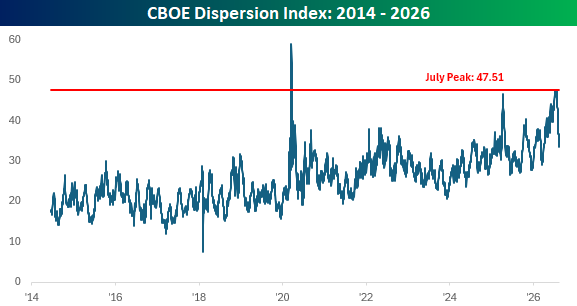
For this week’s Charts of the Week, we are highlighting an indicator that triggered a few weeks ago. The indicator is called the CBOE Dispersion Index, which is a technical name, but the idea is simple: it measures whether individual stocks inside the S&P 500 are expected to move very differently from each other, or more in the same direction.
Source: Bespoke Investment Group.
In late July, the Dispersion Index reached 47.51, one of its highest levels since the COVID crash. In plain English, that meant the market expected a lot of separation beneath the surface, with some stocks moving very differently than others. That type of environment can make the index look calm while individual stocks experience very different results.
Source: Bespoke Investment Group.
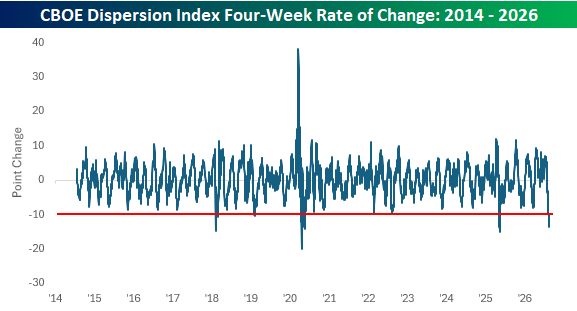
Since then, the index has fallen sharply, dropping by more than 13 points over four weeks. A decline like that suggests stocks may be starting to move more together again. That can be a sign of a healthier market if more companies are participating in the move, rather than performance being driven by only a narrow group of stocks.
Source: Bespoke Investment Group
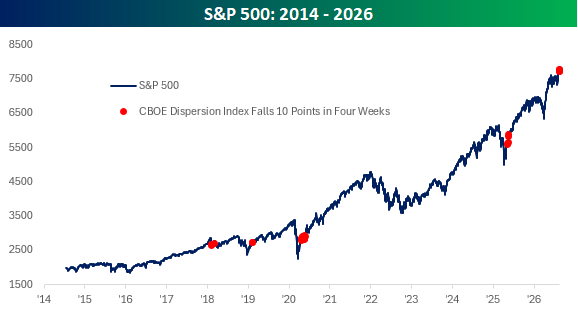
Historically, similar drops in dispersion have often occurred after periods of market stress, near the early stages of a recovery or rally. The sample size is very small, so this should not be treated as a great signal. Still, the past examples are interesting because the S&P 500 was higher one, three, six, and twelve months later in each of the prior four cases.
Source: Bespoke Investment Group
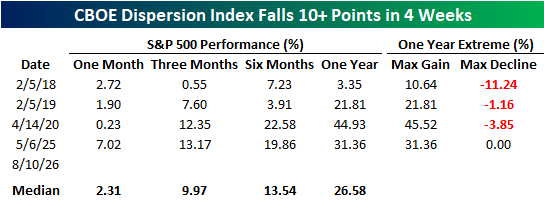
The table shows that following the prior four instances, the S&P 500’s median gain was 2.31% after one month, 9.97% after three months, 13.54% after six months, and 26.58% after one year, all way above long-term averages for each period. Again, four examples are not enough to draw a firm conclusion, but the consistency is notable, nonetheless.
For investors, the key takeaway is that the market may be showing signs of broader participation. When stocks begin moving more together to the upside, it can suggest that strength is spreading beyond a few individual names. While this does not eliminate the risk of short-term volatility, the historical pattern following sharp drops in dispersion has generally been constructive for equities.
Sources: First Trust, Bloomberg, The Canadian Press, Yahoo Finance, Reuters, Bespoke Investment Group
©2026 Milestone Wealth Management Ltd. All rights reserved.
DISCLAIMER: Investing in equities is not guaranteed, values change frequently, and past results are not necessarily an indicator of future performance. Investors cannot invest directly in an index. Index returns do not reflect any fees, expenses, or sales charges. Opinions and estimates are written as of the date of this report and may change without notice. Any commentaries, reports or other content are provided for your information only and are not considered investment advice. Readers should not act on this information without first consulting Milestone, their investment advisor, tax advisor, financial planner, or lawyer. This communication is intended for Canadian residents only and does not constitute as an offer or solicitation by anyone in any jurisdiction in which such an offer is not allowed.